Welcome to the 'Over Rory' page of the Rory Gallagher Collection, a tribute to an exceptional Irish blues guitarist. Here we remember Rory Gallagher, a virtuoso whose life unfortunately ended too early. Our mission is to preserve his musical legacy and share it with a new generation. Discover memorable facts and collectibles that highlight his unique talent and influential career. Enter the world of a guitar legend and let his music live on.
A tribute to a legend
Rory Gallagher, born in Ireland, was more than just a guitarist; he was a blues icon. His passion for music and his virtuoso guitar playing made him loved by fans around the world. On this page we dive into his life, career and the influence he has had on the music world. We strive to keep his music and memory alive so that future generations can get acquainted with his extraordinary talent.
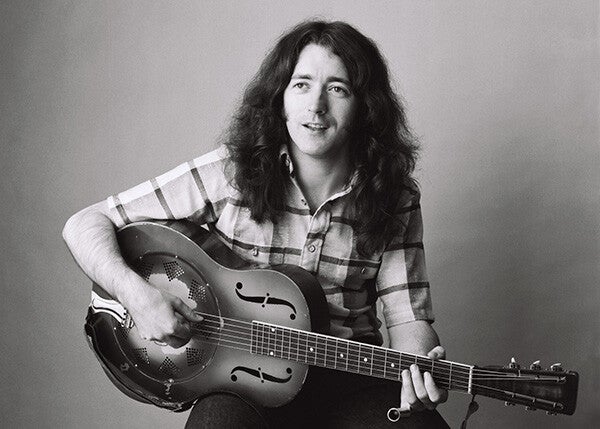
A tribute to a legend
Rory Gallagher, born in Ireland, was more than just a guitarist; he was a blues icon. His passion for music and his virtuoso guitar playing made him loved by fans around the world. On this page we dive into his life, career and the influence he has had on the music world. We strive to keep his music and memory alive so that future generations can get acquainted with his extraordinary talent.
in common
William Rory Gallagher
born on the 2 March 1948 in Ballyshannon was an Irish guitarist, singer, and songwriter. Often described as “Ireland’s first rock star,” he became renowned for his exceptional guitar skills and electrifying live shows. He is also sometimes referred to as “the greatest guitarist you’ve never heard of.” beside the ones that knew/know him....
Gallagher first rose to international fame in the late 1960s as the frontman and lead guitarist of the blues-rock trio Taste. When the band split in 1970, he embarked on a solo career, earning the title Guitarist of the Year from Melody Maker in 1972. Over the course of his career, Gallagher performed more than 2,000 concerts worldwide, including numerous shows in Northern Ireland during the Troubles. His record sales surpassed 30 million globally.
Throughout the 1980s, Gallagher continued to tour and release new music, though shifting trends in the music industry led to a decline in mainstream popularity. His health also worsened, culminating in a liver transplant at King’s College Hospital in London in March 1995. Complications arose when he contracted a staphylococcal infection (MRSA), and he died three months later at the age of 47.
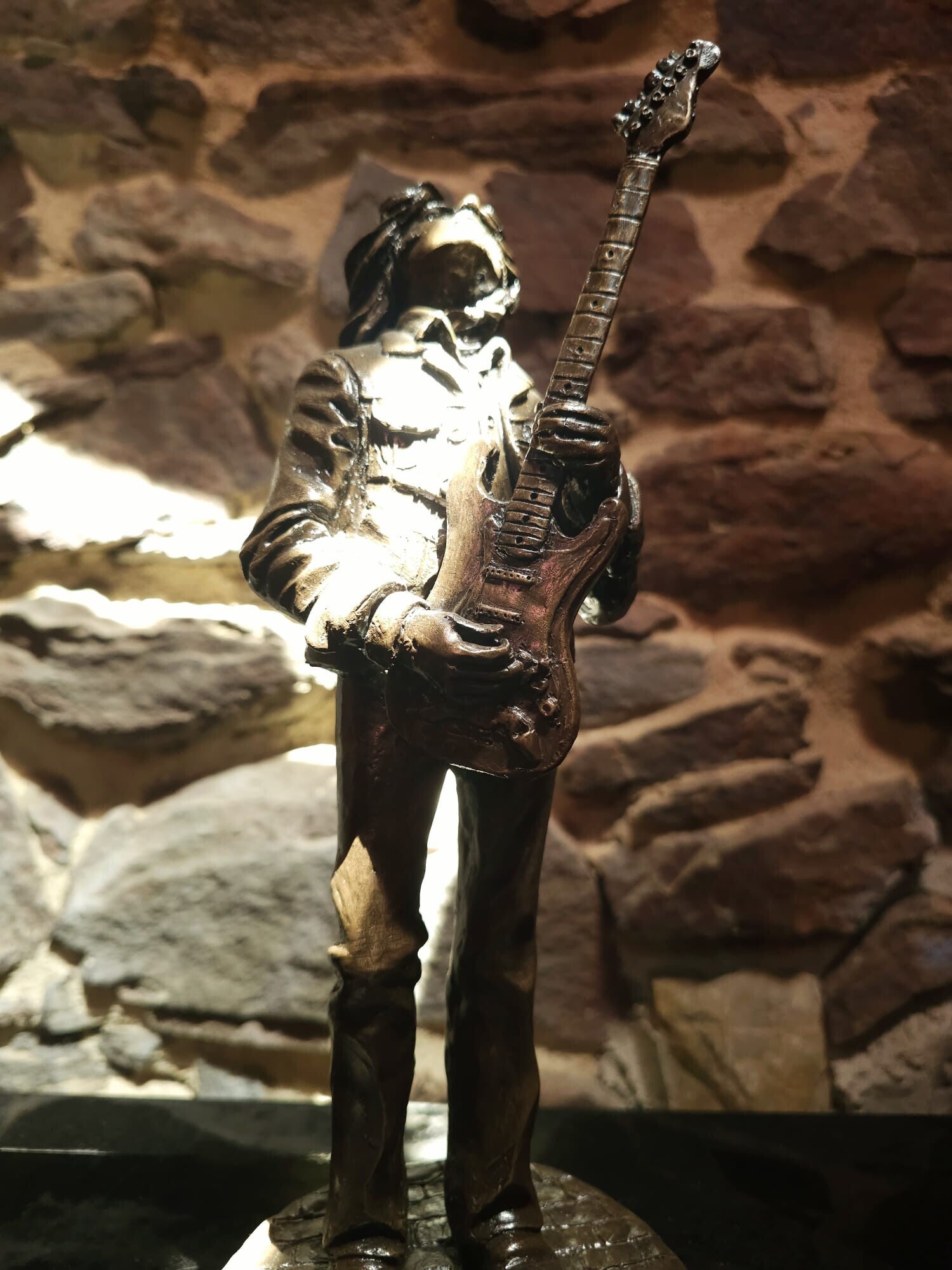
After his death on the 14th if June 1995, Gallagher has been widely commemorated. Statues in Ballyshannon and Belfast, as well as renamed public spaces in Dublin, Cork, and Paris, honour his legacy. He has also appeared on a special An Post stamp series and a Central Bank of Ireland commemorative coin. Since 2002, Ballyshannon has hosted the annual Rory Gallagher International Tribute Festival.
Gallagher’s influence spans generations of rock and blues musicians. Artists such as Brian May, Johnny Marr, Slash, The Edge, Glenn Tipton, Janick Gers, Vivian Campbell, Joan Armatrading, Gary Moore, and Joe Bonamassa have cited him as an inspiration, praising both his musical talent and his character.
His early years
Gallagher was born on 2 March 1948 to Daniel and Monica Gallagher at the Rock Hospital in Ballyshannon, County Donegal, Ireland. He was baptised in the nearby St Joseph’s Church.
His father, Danny, originally from Derry, had served for a period in the Irish Army. He was also an accordionist and led his own dance orchestra. He met Gallagher’s mother, Monica—who was from County Cork—during the 1940s while stationed in Cork city, and the two later married.
The couple moved to Ballyshannon after Danny was demobilised, where he found work with the Irish Electricity Supply Board, which was then constructing the Cathaleen’s Fall hydroelectric power station on the River Erne.
In 1949, the family relocated to Derry City, where Gallagher’s younger brother, Dónal, was born later that year. Dónal would eventually go on to manage Gallagher throughout most of his career. While in Derry, Gallagher attended the Christian Brothers Primary School, known locally as “the Brow of the Hill”.
Over the next seven years, the family moved frequently due to irregular employment, spending periods in Coventry and Birmingham in England, as well as oscillating between Cork and Derry. The instability strained Danny and Monica’s marriage, and in 1956 Monica returned to Cork permanently with her two sons. They lived with Gallagher’s maternal grandparents in an apartment above the Modern Bar (later renamed Roche’s Bar) at 27 MacCurtain Street. Gallagher attended the North Monastery School and later St Kieran’s College.
Gallagher developed a passion for music at a young age through radio broadcasts, tuning in to Radio Luxembourg, the BBC, and the American Forces Network. His earliest musical inspiration was Roy Rogers, “the Singing Cowboy,” followed by Lonnie Donegan, whose skiffle interpretations of American blues and folk artists introduced Gallagher to the genre. He later discovered rock and roll—particularly Buddy Holly, Eddie Cochran, and Chuck Berry—before finding his most significant influence in Muddy Waters. He also cited Woody Guthrie, Big Bill Broonzy, and Lead Belly among his inspirations.
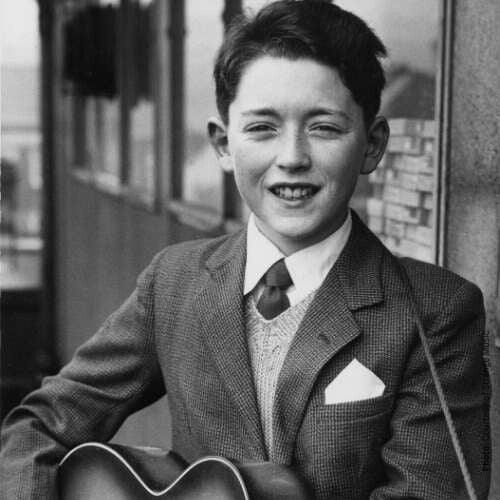
At the age of nine, Gallagher received a plastic Elvis Presley–style ukulele for Christmas, on which he taught himself basic chords. Recognising his talent, his mother later bought him an acoustic guitar. Gallagher studied music books from the local library, such as Lonnie Donegan’s Skiffle Hits, and copied chord shapes from musician photographs in Melody Maker.
After building a repertoire of songs, Gallagher began performing at small local events around Cork, often accompanied by his brother. In 1961, he won a cash prize as a solo performer in a talent competition at Cork City Hall, and his photograph appeared in the Evening Echo.
As Gallagher’s performances became more frequent, he sought to emulate the electric sound of contemporary beat groups. To achieve this, he persuaded his mother to buy him a black Rosetti Solid Seven electric guitar.
His early years
The Showband Years
1963–1965: The Fontana Showband
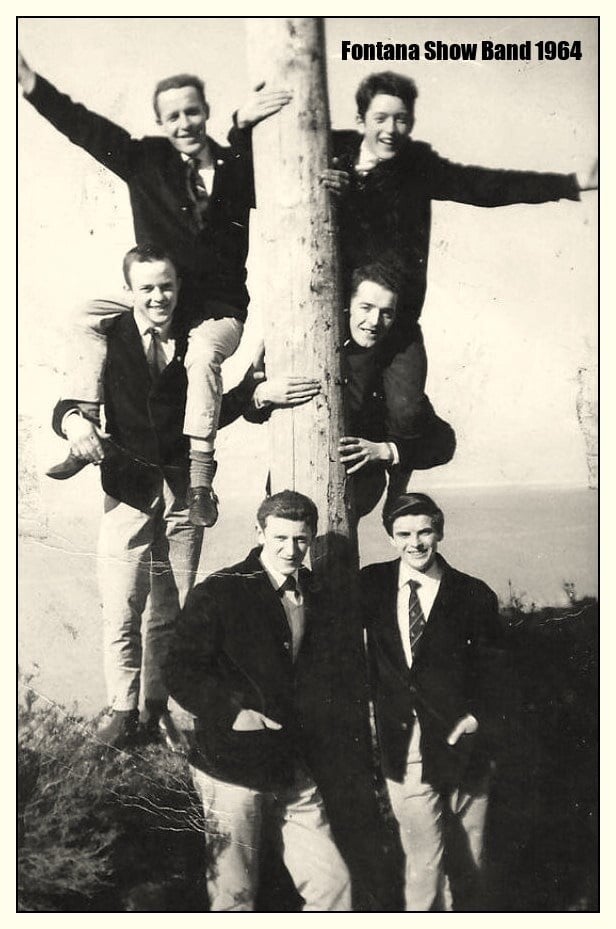
Gallagher was eager to form his own band but struggled to find musicians in Cork who shared his musical interests. In the summer of 1963, while scanning local newspapers, he found an advertisement placed by brothers Oliver and Bernie Tobin, who were seeking a lead guitarist for their newly formed group, the Fontana Showband.
The six-piece ensemble played popular hits of the era and included Bernie Tobin on trombone, Oliver Tobin on bass, John Lehane on saxophone, Eamonn O’Sullivan on drums, and Jimmy Flynn on guitar. Gallagher impressed them at his audition and, after lying about his age, secured the position. Within weeks, Flynn departed by mutual agreement, and Declan O’Keefe joined as rhythm guitarist.
Soon after joining the Fontana Showband, Gallagher bought a 1961 Fender Stratocaster for £100 from Crowley’s Music Shop. This would become his signature instrument throughout his career.
The band performed almost every night in ballrooms and dance halls across Ireland, often playing five to six hours at a stretch. The steady work allowed Gallagher to make his Stratocaster payments. During Lent—when dances were effectively banned by the Catholic Church—the band toured Great Britain.
Although the showband repertoire was far from the music he truly wanted to play, Gallagher considered the Fontana Showband an invaluable training ground. As musical tastes were changing, he gradually introduced new material into their setlist, incorporating Chuck Berry songs and steering the band away from mainstream pop. By 1965, he had reshaped Fontana into a new group, The Impact, with Michael Lehane on keyboards and Johnny Campbell replacing O’Sullivan on drums.
1965–1966: The Impact
On 22 April 1965, The Impact appeared on the Irish television programme Pickin’ the Pops. They were scheduled to perform Buddy Holly’s Valley of Tears, but at the last moment, Gallagher boldly switched to Larry Williams’ Slow Down, creating a sensation.
As Gallagher’s guitar skills attracted wider attention, the band began booking larger venues, including the Arcadia Ballroom, operated by Peter Prendergast. Prendergast’s brother, Phillip, became the band’s manager and secured support slots for major touring acts such as The Animals. Around this time, Gallagher was also invited to play session guitar for the showband The Victors on their recording Call Up the Showbands.
In June 1965, the band travelled to Spain for a residency at a U.S. Air Force base near Madrid, in Alcalá de Henares. Because Spain was under dictatorship at the time, Gallagher was required to cut his hair before entering the country. After the residency, the band recorded their first demo, featuring a cover of Slow Down with Valley of Tears as the B-side.
By early summer 1966, The Impact had disbanded. Gallagher, along with bassist Oliver Tobin and drummer Johnny Campbell, formed a trio and embarked on a three-week engagement at the Big Apple club in Hamburg, Germany, performing under the name The Fendermen.
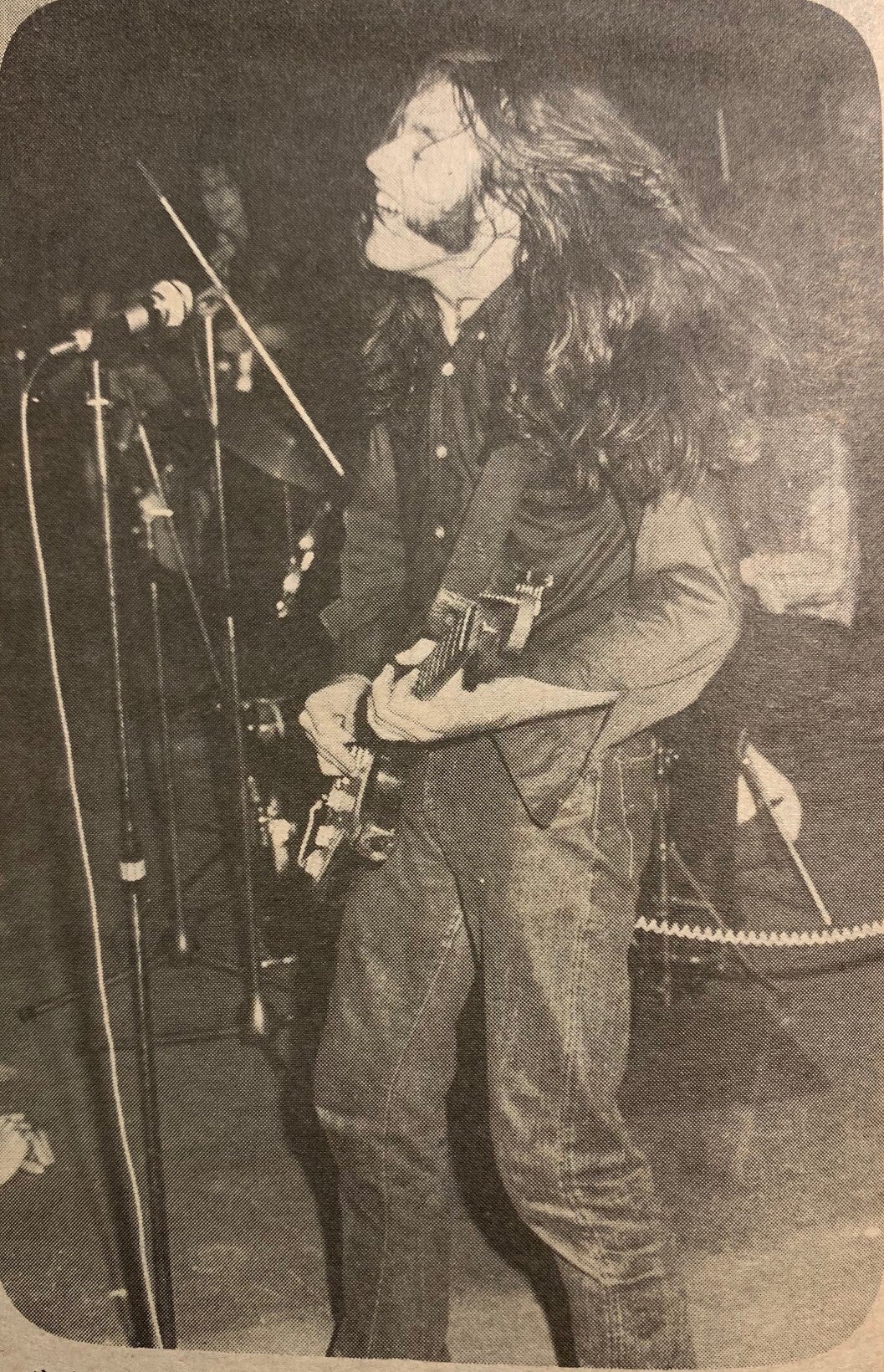
Taste
1966–1968: Taste I
After returning to Ireland, Gallagher jammed with the local Cork band the Axills, which included bassist Eric Kitteringham and drummer Norman Damery. He was offered the role of guitarist, but after completing his musical apprenticeship in the showbands—and inspired by the rise of beat groups—he decided it was time to form his own band. He invited Kitteringham and Damery to join him.
They formed The Taste, later shortened to Taste, a blues-rock and R&B power trio. The band was conceived inside the Long Valley Bar, and the name Taste was inspired by a beermat advertising the superior taste of Beamish stout.
Taste began rehearsing upstairs at 5 Park View, where the Kitteringham family lived, and made their debut on 10 September 1966 at a school dance in the Imperial Hotel on Cork’s Grand Parade. While the band played many covers, they were also developing original material, including an early version of “Blister on the Moon.”
Hoping to tap into Belfast’s growing blues scene, Taste played Sammy Houston’s Jazz Club on Great Victoria Street in December 1966. Their performance attracted the attention of promoter Eddie Kennedy, who offered them both a residency at the Maritime Hotel and a management contract.
Gallagher persuaded Kitteringham and Damery—then working as a printer and an insurance broker—to become full-time musicians, and they agreed. Several months later, Damery’s work replacement died in the Aer Lingus Flight 712 disaster, prompting Damery to tell Gallagher: “Whatever turns out for me professionally now is a bonus. You saved my life.”
During their Maritime Hotel residency, Taste opened for acts like Cream, Fleetwood Mac, and Chris Farlowe & The Thunderbirds, drawing mixed Protestant and Catholic audiences.
In 1967, Phil Solomon’s Major-Minor label invited Taste to record a demo. Without Gallagher’s consent, the label released “Blister on the Moon” (with “Born on the Wrong Side of Time” as the B-side) as a single.
Through Eddie Kennedy’s connections with Robert Stigwood—manager of Cream and the Bee Gees—Taste secured shows at London’s Marquee Club. At their debut performance in February 1968, supporting Robert Hirst and the Big Taste, they were billed as “The Erection” to avoid confusion with the headliner. Their raw sound immediately impressed critics and audiences, earning them a residency and prompting a permanent move to London in summer 1968.
Polydor began expressing interest in signing the band, but Kennedy claimed the label wanted a stronger rhythm section. Despite Gallagher’s initial resistance, Kitteringham and Damery were ultimately replaced by Belfast musicians Richard McCracken (bass) and John Wilson (drums), both formerly of the band Cheese. The split was amicable, as all parties felt the change was necessary for the band’s progression.
1968–1970: Taste II
In August 1968, the new Taste lineup signed with Polydor and relocated to Earl’s Court. Gallagher bought a saxophone during this time and taught himself to play it, practicing in a cupboard to avoid disturbing neighbours.
Three months later, at Eric Clapton’s request, Taste supported Cream at its farewell concerts at the Royal Albert Hall. After Cream dissolved, manager Robert Stigwood approached Gallagher with an offer to join Jack Bruce and Ginger Baker in a new version of the band. Gallagher refused outright.
In early 1969, Taste recorded their debut album Taste in a single day at De Lane Lea Studios in London. Produced by Tony Colton—who had worked with Yes—the record featured rearranged blues standards such as “Leavin’ Blues,” “Sugar Mama,” and “Catfish,” a cover of Hank Snow’s “I’m Movin’ On,” and Gallagher’s original “Blister on the Moon.” Critics praised its “raw and honest” sound, and the album performed especially well in Northern Europe.
In July 1969, Clapton invited Taste to support his new supergroup Blind Faith on their U.S. tour. Despite strong audience response, the tour proved difficult: Taste were denied soundchecks, proper PA support, and were limited to daytime arena slots. Conflicts arose with Kennedy over travel arrangements and his refusal to let the band remain in the U.S. afterward to play club shows. While in New York, Gallagher saw Muddy Waters perform for the first time at Ungano’s.
After returning to London, Polydor asked Taste to begin work on a second album. This time they were given nearly a week in the studio. The result, On the Boards, showcased Gallagher’s progressive blues style—combining blues-rock, acoustic ballads, and experimental jazz-blues fusion. Released in January 1970, it reached No. 18 on the UK Albums Chart. Without Gallagher’s approval, Polydor issued its opening track, “What’s Going On,” as a single in Germany, where it became a Top 5 hit.
Throughout 1970, Taste grew rapidly as a live attraction, breaking the Marquee Club’s all-time box-office record on 21 July, surpassing Jimi Hendrix’s previous record. John Lennon, after attending one of their shows, told New Musical Express: “I heard Taste for the first time the other day and that bloke is going places.”
Behind the scenes, however, tensions were rising. Gallagher and his brother Dónal were aware that Kennedy was misappropriating band funds, but Wilson and McCracken sided with the manager, causing a deep rift. Matters worsened when Taste’s van was broken into the night before their Isle of Wight Festival appearance, and Wilson accused Gallagher of staging the theft because only his drum pedals were stolen.
Despite internal conflict, Taste delivered a powerful performance at the Isle of Wight Festival before an audience of roughly 600,000, returning for multiple encores. The entire performance was filmed by Murray Lerner and eventually released as Live at the Isle of Wight (2015).
Gallagher had intended to dissolve the band after the festival, believing Taste had “come to the end of our natural life.” However, contractual obligations forced them to continue. Three days later, they performed at the Montreux Jazz Festival—Gallagher’s first of many appearances there.
Taste played their final concert on 24 October 1970 at Queen’s University, Belfast. Afterward, Gallagher never again performed a released Taste song on stage. McCracken and Wilson later formed the rock band Stud.
Although Gallagher described the breakup as “traumatic” and “dreadful,” especially since “the press all attacked me as if I was some kind of dictator,” he refused to speak negatively about the other members. He later reflected that the split was a “communications breakdown” that “shouldn’t have been allowed to happen.”
Meanwhile, Dónal, now acting as Gallagher’s manager, insisted they take Eddie Kennedy to court to reclaim unpaid royalties. Kennedy capitulated before trial, agreeing to transfer the rights but claiming he had no money. Gallagher therefore never received income from Taste’s album sales. The ordeal made him deeply cautious of large management deals in the future.
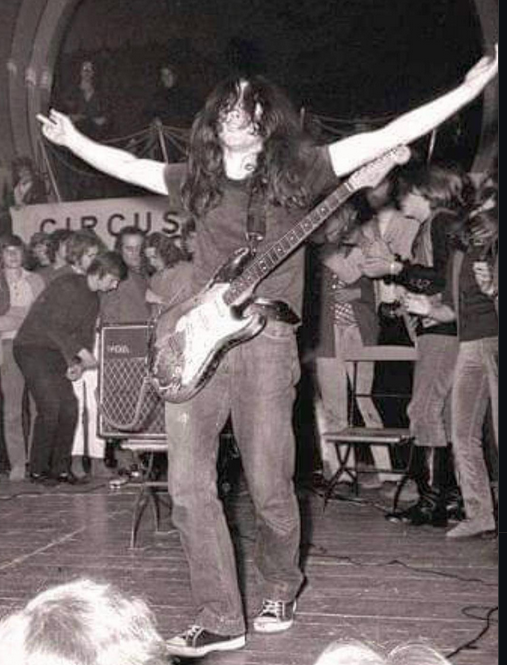
1971–1972 Rory Gallagher I
After Taste split, Gallagher launched his solo career with his brother Dónal as manager and their own company, Strange Music, to control his song rights. With help from Led Zeppelin manager Peter Grant, he signed a six-album deal with Polydor on far better terms than he’d had with Taste.
He formed a new trio with Belfast musicians Gerry McAvoy (bass) and Wilgar Campbell (drums), formerly of Deep Joy. The chemistry was immediate, and they debuted at the Paris Olympia in March 1971, appearing at major festivals later that year.
Gallagher borrowed money from his mother to record his first solo album, Rory Gallagher (1971), a largely live-in-the-studio record that blended blues, folk and jazz and reflected the emotional fall-out from Taste’s breakup. Six months later he released Deuce, recorded quickly to capture a raw, gig-like feel. Both albums were praised in the music press and later became cult favourites among fans and fellow musicians.
In late 1971, Gallagher recorded with one of his heroes, Muddy Waters, on The London Muddy Waters Sessions, calling the experience a “special memory”. In 1972 he issued his first live album, Live! In Europe, taken from shows across the continent. It reached the UK Top 10 and earned him his first Gold Disc, confirming his reputation as a formidable live performer. That same year he was voted “Guitarist of the Year” in a Melody Maker readers’ poll. As touring became more intense, Campbell developed a fear of flying and, after a series of missed shows, left the band.
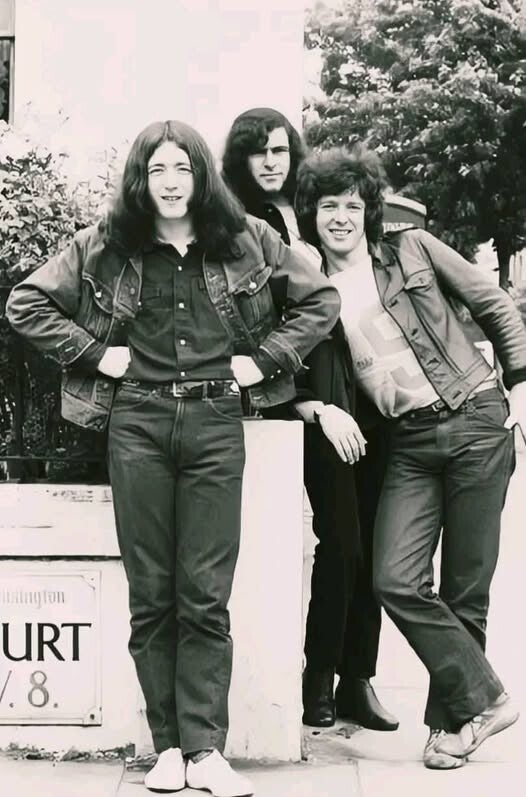
1972–1978 Rory Gallagher II
Drummer Rod de’Ath replaced Campbell, and Gallagher expanded the group by adding keyboardist Lou Martin. This new four-piece debuted in July 1972 and recorded two studio albums in 1973: Blueprint and Tattoo. Critics felt Blueprint showed a band still finding its identity, but Tattoo was widely praised for its broader palette and produced future live staples like “Tattoo’d Lady” and “A Million Miles Away”.
Gallagher’s profile grew steadily. He contributed to Jerry Lee Lewis’s all-star album The Session… Recorded in London with Great Artists, appeared frequently on European TV and radio, and became one of the BBC’s most-recorded rock musicians of the decade. He toured relentlessly across Europe, North America and Japan, but always returned to Ireland for a Christmas tour. At the height of the Troubles he insisted on playing Belfast, earning deep loyalty from Irish fans and inspiring a generation of local musicians.
The 1974 double live album Irish Tour ’74, drawn from concerts in Belfast, Dublin and Cork, went gold in the UK and sold over two million copies worldwide. The accompanying documentary, also titled Irish Tour ’74, further cemented his image as a tireless, no-nonsense live artist.
By the mid-1970s Gallagher was courted by major acts. In 1975 he spent three days jamming with the Rolling Stones as they auditioned guitarists to replace Mick Taylor, but was ultimately deemed too strong-willed to “fit” into the band’s hierarchy. That same year he signed with Chrysalis Records and released Against the Grain, which he felt finally captured his live sound in the studio. Calling Card followed in 1976, produced by Roger Glover of Deep Purple, and was noted for its stylistic range—from rock and blues to funk and folk.
Gallagher toured behind these albums across Europe, including Communist-era Poland, where his sanctioned concerts drew fans from both sides of the Iron Curtain and attracted international press attention. In 1977 he became a key figure in the German TV show Rockpalast, drawing tens of millions of viewers, and headlined Ireland’s first open-air rock festival at Macroom.
Towards the end of the decade, however, lengthy studio sessions in San Francisco with producer Elliot Mazer left Gallagher unhappy with both the sound and the spiralling costs. Feeling the album didn’t represent him honestly, he scrapped it entirely—on the day it was due to be delivered—and soon let de’Ath and Martin go. Their final show together took place at London’s Hammersmith Odeon in April 1978. The material would only surface decades later as Notes From San Francisco.
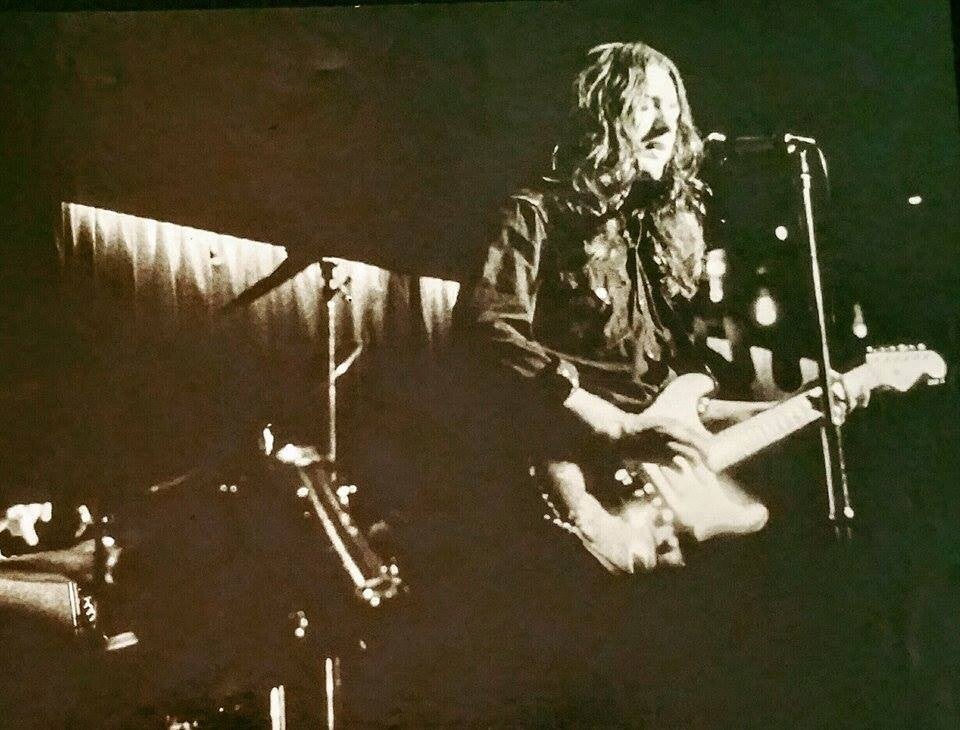
1978–1981 Rory Gallagher III
Returning to a power-trio format, Gallagher recruited drummer Ted McKenna (ex–Sensational Alex Harvey Band) to join him and McAvoy. They recorded Photo-Finish (1978) at Dierks Studios in Germany, a tougher, more hard-rock-oriented album that reworked some of the San Francisco material and introduced new songs like “Shin Kicker” and “Shadow Play”. Critics praised its urgency, though some missed the acoustic and folk elements of earlier work.
He followed with Top Priority (1979), again recorded at Dierks, further emphasising a heavier rock direction under pressure from label expectations and the rise of the New Wave of British Heavy Metal. Gallagher was ambivalent about trend-chasing but felt the record was still “modern and valid” on his own terms.
During this period he toured relentlessly, including Portugal (where he was one of the first rock acts to perform after the Carnation Revolution) and multiple returns to Montreux and Reading. He set box-office records and received special awards for his frequent headline appearances. The 1980 live album Stage Struck documented this louder, faster era of the band. In early 1981 McKenna left amicably to pursue other musical avenues.
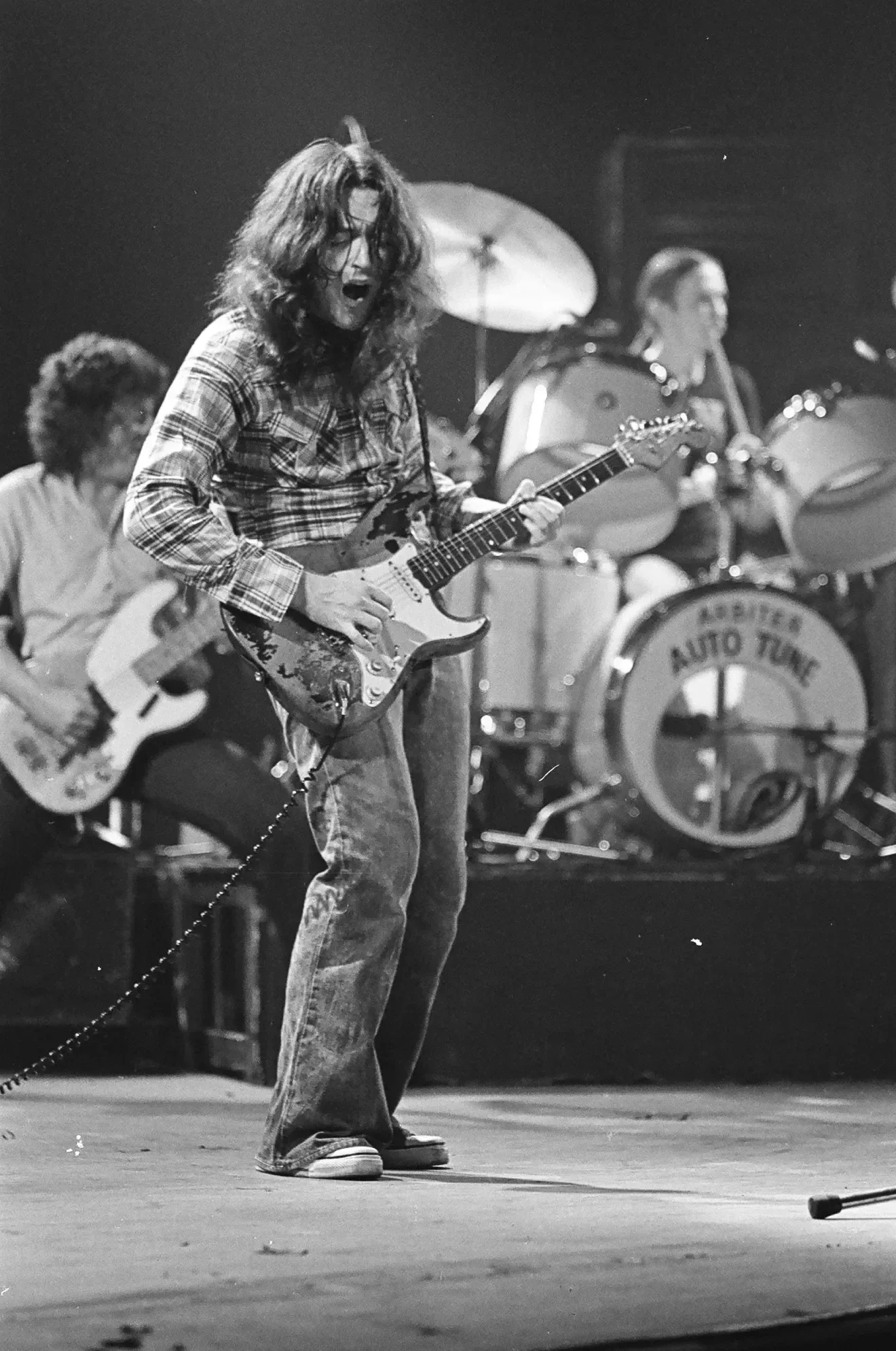
1981–1991 Rory Gallagher IV
Gallagher’s next drummer was Brendan O’Neill, another Belfast musician and an old friend of McAvoy’s. The trio recorded Jinx (1982) at Dierks, with Gallagher seeing it as a return to the feel of Tattoo and Against the Grain. Despite his affection for the record, it suffered from poor label support and changing musical fashions, becoming one of his least commercially successful albums.
Live, he remained a formidable draw. He won “Best Musician” at the Stag/Hot Press Awards and played some of his most intense shows, including a notorious concert in Athens where a crowd far larger than expected sparked a riot, leaving hundreds injured and Gallagher temporarily blinded by tear gas. He continued to tour, receiving various performance awards and joining friends like Phil Lynott and Paul Brady on stage at key Irish events.
In the early 1980s he began work on an ambitious, sax-heavy album provisionally titled Torch, but eventually abandoned it in frustration, deciding to start over. The project that emerged instead was Defender (1987), released on his own Capo label through UK indie Demon Records. The album blended his blues roots with noir-inspired storytelling on songs like “Loanshark Blues”, “Kickback City” and “Continental Op”. It topped the UK Independent Albums Chart, became one of Demon’s best-selling records and won “Best Album” at the 1988 Stag/Hot Press Rock Awards.
During this time Gallagher increasingly valued independence. With Capo and Demon he enjoyed artistic freedom without pressure to chase hit singles or TV mime appearances. He remained active in session work with artists such as The Fureys, Davy Spillane and Phil Coulter, and participated in high-profile benefit concerts, including Self Aid in 1986.
His health, however, began to decline, and he grew more reliant on prescription medication, even as he continued to tour. In 1990 he released Fresh Evidence, his final studio album, a modern-sounding but vintage-inspired blues record that critics saw as evidence of a mature artist confidently revisiting his influences. That same year he was offered a role in the film version of The Commitments but declined due to discomfort with the script’s heavy swearing.
By late 1990 long-time bandmates McAvoy and O’Neill decided to depart, joining Nine Below Zero after one final world tour with Gallagher, which included a memorable on-stage jam with Slash at the Roxy in Los Angeles and a chaotic final New York show cut short by overcrowding.
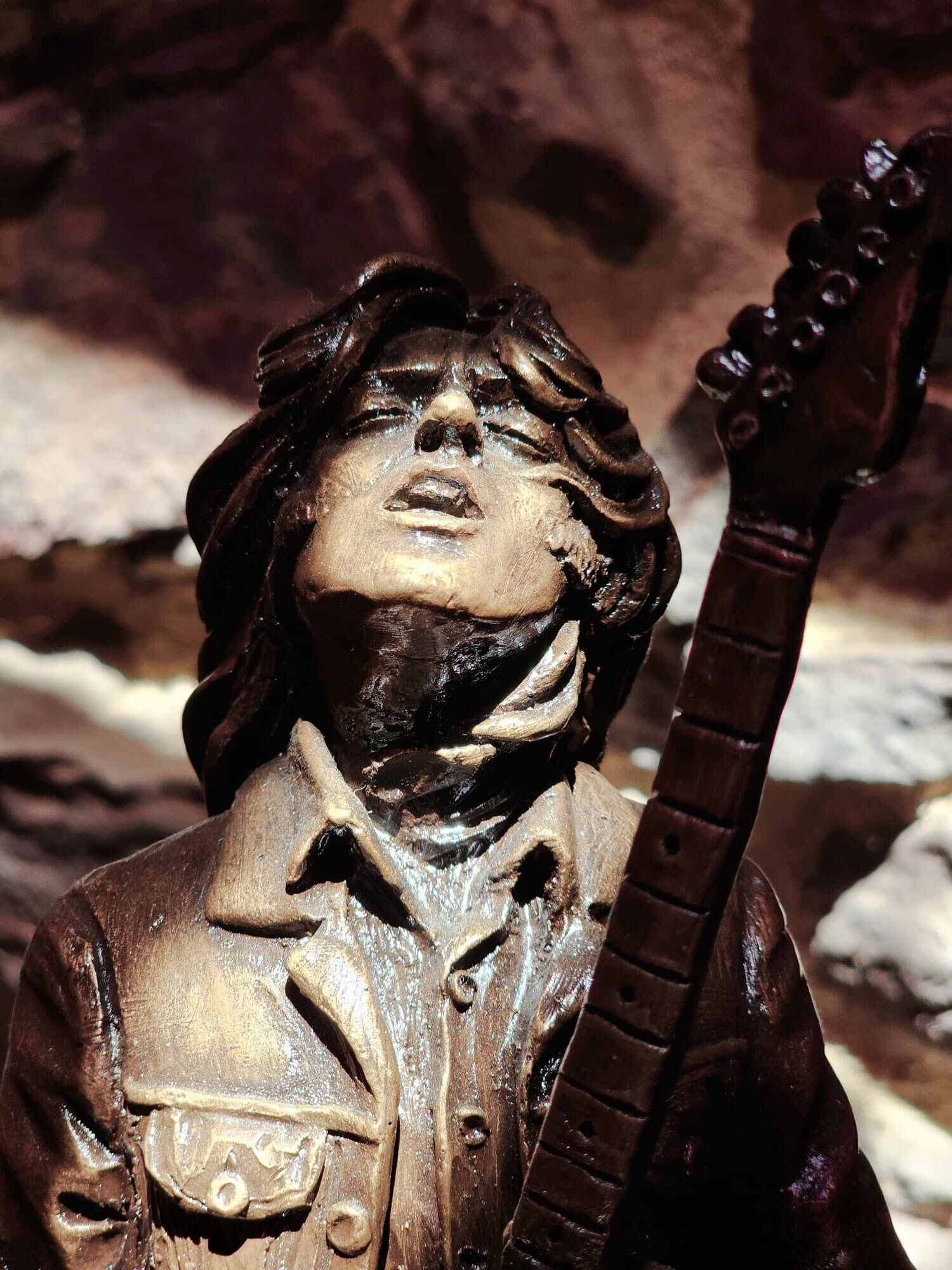
1991–1992 The pause
The departure of his long-standing rhythm section hit Gallagher hard. Those close to him, including director Tony Palmer, felt he was affected by a period of depression and uncertainty. He stepped back to reassess his future, vowing to be more flexible with line-ups and to avoid long-term commitments that might weigh on him.
Despite not having a permanent band, he stayed musically active: he played on Stiff Little Fingers’ track “Human Shield” and took part in a TV documentary on the history of the Fender Stratocaster, later incorporated into Stratmasters. In 1992 he briefly reunited with McAvoy and O’Neill for a show at the Scottish Fleadh in Glasgow, with violinist Roberto Manes guesting.
1992–1995 Rory Gallagher V
On the recommendation of Jim Leverton, Gallagher brought in drummer Richard Newman, who then suggested bassist David Levy. Leverton occasionally filled in on keyboards when John Cooke was unavailable, giving the new band a slightly different feel. According to Dónal, Rory was genuinely pleased with this final incarnation of his group.
The new line-up debuted in Rhyl, Wales, in August 1992, and Gallagher soon headlined the inaugural Temple Bar Blues Festival in Dublin, where he also gave a masterclass and received the Fender/Arbiter Hall of Fame Award. He played to tens of thousands at free outdoor concerts such as Lark by the Lee in Cork and was honoured by his hometown with a civic reception at City Hall, where the Lord Mayor hailed him as one of Cork’s greatest sons.
Even as his health worsened—and occasionally forced concerts to end early—Gallagher kept touring. He headlined European festivals including Bonn Blues, and in late 1992 released the G-Men Bootleg Series Volume 1, a move he described as “bootlegging the bootleggers” to reclaim his own recordings.
In 1993 he fronted a Fender Stratocaster 40th-anniversary concert in Manchester and later that year played an intimate acoustic set at Cork’s Regional Technical College in tribute to his uncle, the former principal. This would be his final performance in Ireland. He continued to tour Europe in 1994, appearing at Pistoia, Montreux, Stuttgart and Lorient, where he drew record crowds and jammed with local hero Dan Ar Braz.
Despite continuing health problems, he remained in demand as a guest musician, contributing to projects by The Dubliners, Energy Orchard, and others, and recording acoustic demos later issued on Wheels Within Wheels. His last TV appearance came in 1994 on Rock ’n the North, a series about Northern Ireland’s musical history.
In January 1995, determined not to let fans down, Gallagher embarked on a short Dutch tour, though he was clearly very unwell. Shows in several cities went ahead, but the final concert in Rotterdam had to be cut short, and the remaining dates were cancelled. It was the final tour of his life.